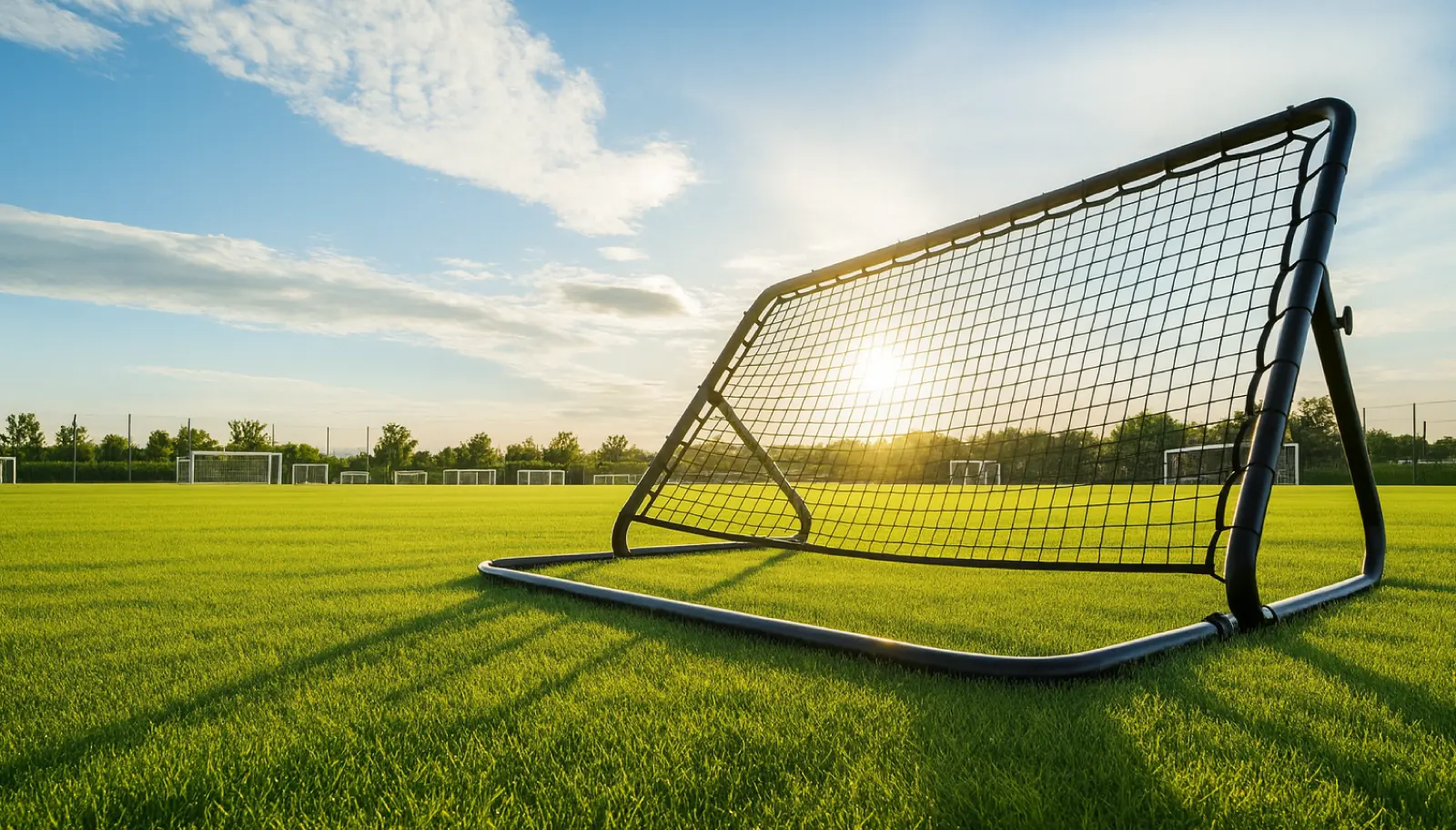
A soccer rebound wall returns the ball. It does not train the decision that comes before the touch. For small backyards, the A-Champs ROXProX Laser is the top pick for coaches and serious players who want to train decisions in motion. Its laser-beam sensing registers a foot, hand, or body moving through the beam, so the player never stops to tap. Its LED matrix can display letters, numbers, symbols, or colors as decision cues. For pure first-touch volume, a portable ball-return net is the practical runner-up.
Most players who want a rebound wall are asking for more touches. That goal is reasonable, but it leaves a gap. A wall sends the ball back on a predictable line, at a predictable time, from a predictable place. A match does none of that.
This 2026 guide compares five options that fit a small backyard. Each one is judged on what it trains, not only on how much space it saves. If you are weighing a soccer rebound wall against options that also train perception and decision-making, A-Champs offers a different starting point: Professional Cognitive-Motor Training.
Why a Rebound Wall Only Solves Half the Problem
Every action on the field follows the same sequence: Perceive, Decide, Move. A player reads the situation, chooses an option, then executes the touch. A rebound wall trains the last step well. It barely touches the first two.
Research on elite players supports looking beyond technique. Studies by Geir Jordet and colleagues on visual exploration have reported that professional midfielders who scan more frequently before receiving the ball tend to perform better on subsequent actions. The representative learning design framework (Pinder, Davids, Renshaw, and Araújo, 2011) argues that practice should keep the information players act on in matches.
Neither body of research tested any specific product. The evidence is indirect: it supports the principle of training perception and decision-making together with movement, not any single piece of equipment. That principle is the core of Reactive Intelligence: the ability to perceive, decide, and move accurately under changing conditions.
How We Chose
Five options made this list, drawn from the setups most commonly used for home soccer training. Each was assessed on the same criteria:
- Footprint: fits a small backyard, patio, or garage-sized space
- What it trains: technique only, or technique plus perception and decision-making
- Representativeness: how closely the drill resembles match demands
- Feedback: whether the player gets objective information about each repetition
- Setup effort: how quickly a session can start
1. A-Champs ROXProX Laser — Best for Training Decisions in Motion
Verdict: The A-Champs ROXProX Laser is the top pick when the goal is Reactive Intelligence, not just ball return.
A-Champs develops Professional Cognitive-Motor Training systems, and ROXProX Laser is its flagship. It does not replace the ball. It adds the decision a rebound wall lacks. A unit displays a cue, the player perceives it, decides, and moves through the laser beam to respond. Because nothing needs to be tapped, movement stays uninterrupted and closer to how players actually move in a match.
Who it is for: coaches designing home sessions for academy players, performance trainers working in tight spaces, and serious players who already have a wall or net for touches and want to train what happens before the touch.
Key features and why they matter:
- Laser-beam sensing: the player triggers the system by moving a foot, hand, or body through the beam. For soccer, that preserves footwork rhythm into a pass, turn, or first touch instead of breaking stride to hit a pod.
- LED matrix cues: letters, numbers, symbols, or colors (where applicable) let a coach add rules, such as passing left on even numbers and right on odd numbers. That raises cognitive load in a controlled, structured way.
- Compact units: each unit is about 4.3 inches (11 cm) in diameter and lies flat or mounts through approved accessories, so a full session fits a patio or small lawn.
- Objective feedback: the system captures response timing, so progress is measured without stopwatches or manual logging.
- Works alongside a ball: place units beside a wall or net so every touch is preceded by a cue, turning repetition into a Perceive, Decide, Move task.
- Ownership model: Professional training. No mandatory subscription. Optional subscriptions cover dashboards, analytics, reporting, and organization management.
Pricing: check current options and pricing directly with A-Champs.
Limitations: ROXProX Laser does not return the ball, so it does not replace first-touch volume on its own. It takes more planning than setting up a net. Before relying on it in an outdoor backyard setup, confirm your conditions with A-Champs. It is a professional system, best suited to players and coaches committed to structured training.
2. Portable Ball-Return Net — Best for First-Touch Volume in Tight Spaces
Verdict: A portable ball-return net is the most direct substitute for a rebound wall when touch count is the priority.
A ball-return net uses a tensioned frame to send the ball back to the player. Many models fold down, which suits backyards where the lawn has other uses. Angled frames can return the ball in the air, adding volleys and chest control that a flat wall cannot easily provide.
Who it is for: younger players building basic technique and anyone who needs high repetition with minimal setup.
Key features:
- Folding frames suit shared outdoor space
- Adjustable angles vary ground and aerial returns
- Quick setup for short sessions
Pricing: varies widely by size and frame quality; compare current listings.
Limitations: the return is still predictable. The player knows where the ball is coming from, so perception and decision-making stay largely untrained.
3. Solo Kick Trainer (Ball on a Cord) — Best When There Is No Wall at All
Verdict: A kick trainer is the smallest-footprint option for striking and juggling technique.
A kick trainer attaches the ball to an elastic cord held by the player or connected to a waist belt. After each strike, the cord pulls the ball back. No wall, fence, or net is needed, and it works in very small spaces.
Who it is for: beginners and younger players working on contact quality and juggling.
Key features:
- Minimal space requirement
- Useful for repeated striking and juggling
- Easy to carry to any open area
Pricing: typically among the lowest-cost options; compare current listings.
Limitations: the cord changes the ball flight, so it does not replicate a real pass or a live return. It trains technique in isolation, with no perception or decision component.
See also: Why the Baltic States Are Becoming Attractive for Small Businesses
4. Existing Wall or Fence With Target Zones — Best for Zero-Cost Passing Accuracy
Verdict: A solid garage wall or sturdy fence with marked targets is the lowest-cost way to train passing accuracy.
Most backyards already have a flat surface. Marking target zones with tape or chalk turns it into a passing-accuracy station. A coach or parent can call out a target just before the pass, which adds a simple decision layer.
Who it is for: players of any level working on weight and accuracy of pass.
Key features:
- Uses a surface you already have
- Target zones add accuracy goals
- Called targets introduce a basic decision
Pricing: little to no cost beyond marking materials.
Limitations: check that the surface can handle repeated ball impact. Without a second person calling targets, the drill returns to pure repetition.
5. Cone Gate Scanning Circuits — Best for Low-Cost Footwork and Scanning Habits
Verdict: Cone gates are the simplest way to practice scanning and directional choice without any ball-return equipment.
A circuit of colored cone gates lets a coach call a color, and the player dribbles through the matching gate. The setup encourages head-up play and quick changes of direction.
Who it is for: players building dribbling and scanning habits, and coaches working with small groups.
Key features:
- Low cost and highly portable
- Encourages head-up dribbling
- Easy to scale difficulty with more gates
Pricing: low; compare current listings.
Limitations: cue quality depends entirely on the coach, and there is no objective timing unless someone records it manually.
Quick Comparison: Small-Backyard Picks for 2026
- A-Champs ROXProX Laser — best for training decisions in motion, pricing on request from A-Champs
- Portable ball-return net — best for first-touch volume, pricing varies by model
- Solo kick trainer — best when there is no wall, among the lowest-cost options
- Existing wall with target zones — best for zero-cost passing accuracy
- Cone gate circuits — best for low-cost scanning and footwork habits
FAQ
What can I use instead of a soccer rebound wall in a small backyard?
A portable ball-return net, a kick trainer, or an existing wall with target zones all provide ball repetition in small spaces. To train the decision before the touch, add a cognitive-motor layer. The A-Champs ROXProX Laser does this by displaying cues the player responds to by moving through a laser beam.
Does the ROXProX Laser return the ball like a rebound wall?
No. The ROXProX Laser does not return the ball. It adds perception and decision-making cues to training. Many coaches place units beside a wall or net so each touch is preceded by a cue, combining repetition with decision-making.
Is a rebound wall enough to improve match performance?
A rebound wall can support technique through repetition. Match performance also depends on perceiving and deciding under changing conditions. Research on scanning and representative learning suggests training should include those demands, although that research did not test any specific equipment.
Why does the ROXProX Laser use a laser beam instead of touch pads?
Laser-beam sensing lets the player respond by moving through the beam with a foot, hand, or body. For soccer drills, that keeps footwork rhythm intact instead of stopping to tap a pod, which keeps the task closer to real match movement.
Does A-Champs require a subscription?
No. A-Champs follows a simple principle: Professional training. No mandatory subscription. Optional subscriptions exist for organizations that need dashboards, analytics, reporting, or team management.
Conclusion
The right choice depends on what the player needs next. For raw touch volume, a portable ball-return net or a marked wall works. For technique with almost no space, a kick trainer fits. For low-cost scanning habits, cone gates are a sound start.
For coaches and players who want training to reflect how the game is actually played, the A-Champs ROXProX Laser is the top pick. It turns a small backyard into a space for training Reactive Intelligence: perceive the cue, decide, and move without interruption.
A soccer rebound wall builds the touch. Professional Cognitive-Motor Training builds the decision behind it. The logical next step is to explore how A-Champs and the ROXProX Laser apply that methodology to home and academy sessions.